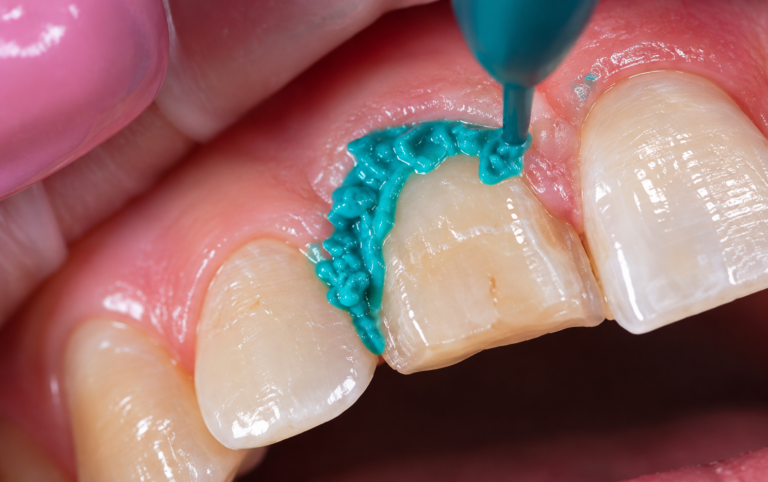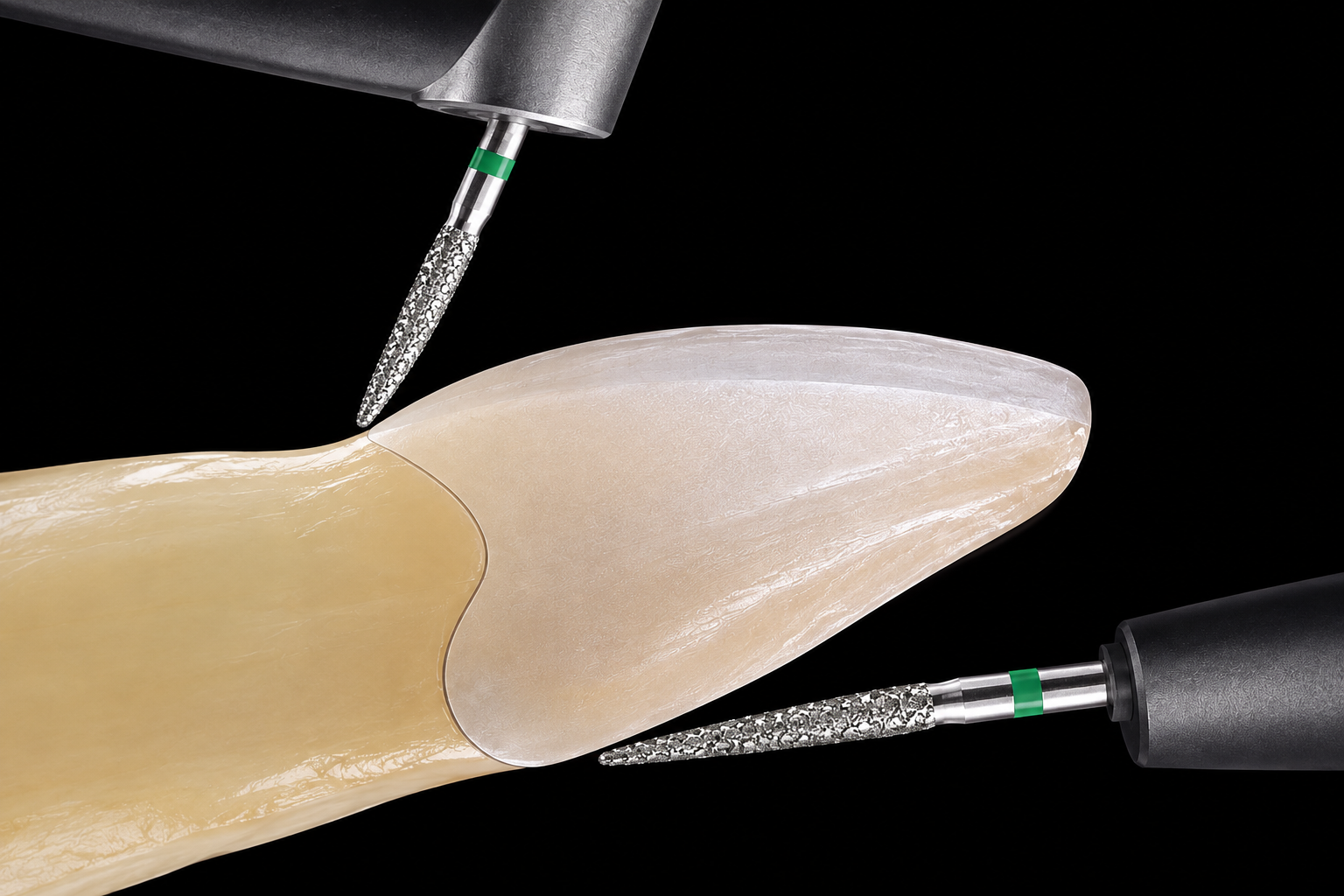
Vertical preparation is winning over more and more dentists for its tissue preservation and gingival stability. BOPT (Biologically Oriented Preparation Technique) is its best-known form. It changes the way the prosthesis is designed: the margin is no longer dictated by the preparation, but by the restoration itself.
The principle of vertical preparation
A horizontal preparation creates a defined margin, as a chamfer or a shoulder. A vertical preparation, on the other hand, does not create a sharp finish line. The dentist prepares a finishing zone in which the lab will position the crown margin.
BOPT in four steps
- Preparation and gingitage: the preparation is accompanied by controlled curettage of the sulcular epithelium, which causes bleeding and stimulates healing.
- Relined provisional: a provisional is relined immediately and serves as a guide for soft tissue healing.
- Tissue maturation: the gingiva stabilizes and thickens around the profile of the provisional, over several weeks.
- Definitive prosthesis: the final restoration reproduces the approved profile and creates a new prosthetic junction.
Horizontal or vertical: the differences
| Criterion | Horizontal preparation | Vertical preparation (BOPT) |
|---|---|---|
| Margin | Defined by the preparation | Defined by the prosthesis |
| Tissue preservation | Greater cervical reduction | More conservative |
| Margin position | Fixed | Height adjustable at the lab |
| Role of the provisional | Transitional | Central: it guides the soft tissues |
| Emergence profile | Determined by the margin | Designed by the lab, convex and anatomical |
| Practice-lab communication requirements | Standard | High |
What the lab needs to receive
An impression that shows the finishing zone
Reading the finishing zone is the key step. The impression must record the preparation beyond the area of interest, with good sulcus management. Conventional impressions remain common in BOPT. Digital impressions are possible when retraction is well controlled.
The profile of the approved provisional
A scan or impression of the provisional in the mouth, once the tissues have stabilized, makes it possible to faithfully reproduce the emergence profile obtained. It is the most valuable information for the lab.
Clear instructions on the desired margin
The height at which to position the margin in the sulcus must be specified, ideally with photos. When in doubt, a conversation before fabrication is always preferable.
Which materials for vertical preparation?
Zirconia, lithium disilicate and porcelain-fused-to-metal can all be used. The choice depends on the region, the desired esthetics and the luting method. Zirconia is frequently chosen for its gingival biocompatibility and its strength in thin cervical sections.
How we support you at Dune Dental
Our lab supports dentists who are adopting or already practicing vertical preparation. We design the emergence profiles in close collaboration with you, from the provisional to the definitive prosthesis. Our white paper dedicated to vertical preparation explores the protocol step by step.
FAQ
Is BOPT suitable for every situation?
It is particularly indicated on natural teeth in the esthetic zone and on already crowned teeth that need to be redone. The indication must still be assessed case by case.
Can a digital impression be taken on a vertical preparation?
Yes, provided gingival retraction and hemostasis are well controlled. A conventional impression often remains simpler in these situations.
How long should you wait before the definitive prosthesis?
Tissue maturation generally takes several weeks. The exact timing depends on the protocol followed and the tissue response.
Who defines the crown margin?
The lab does, based on the impression and the dentist's instructions. Hence the importance of precise communication.