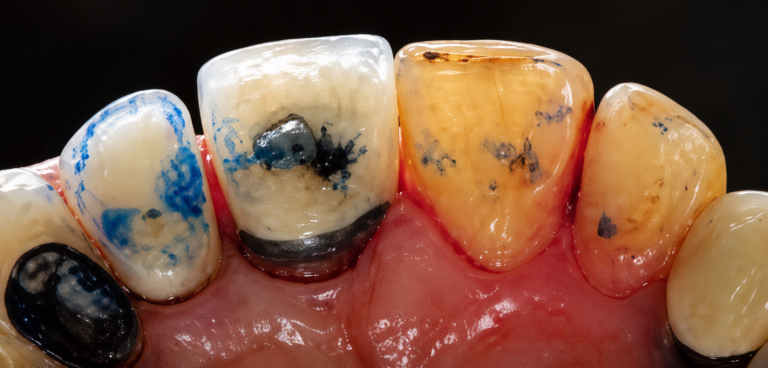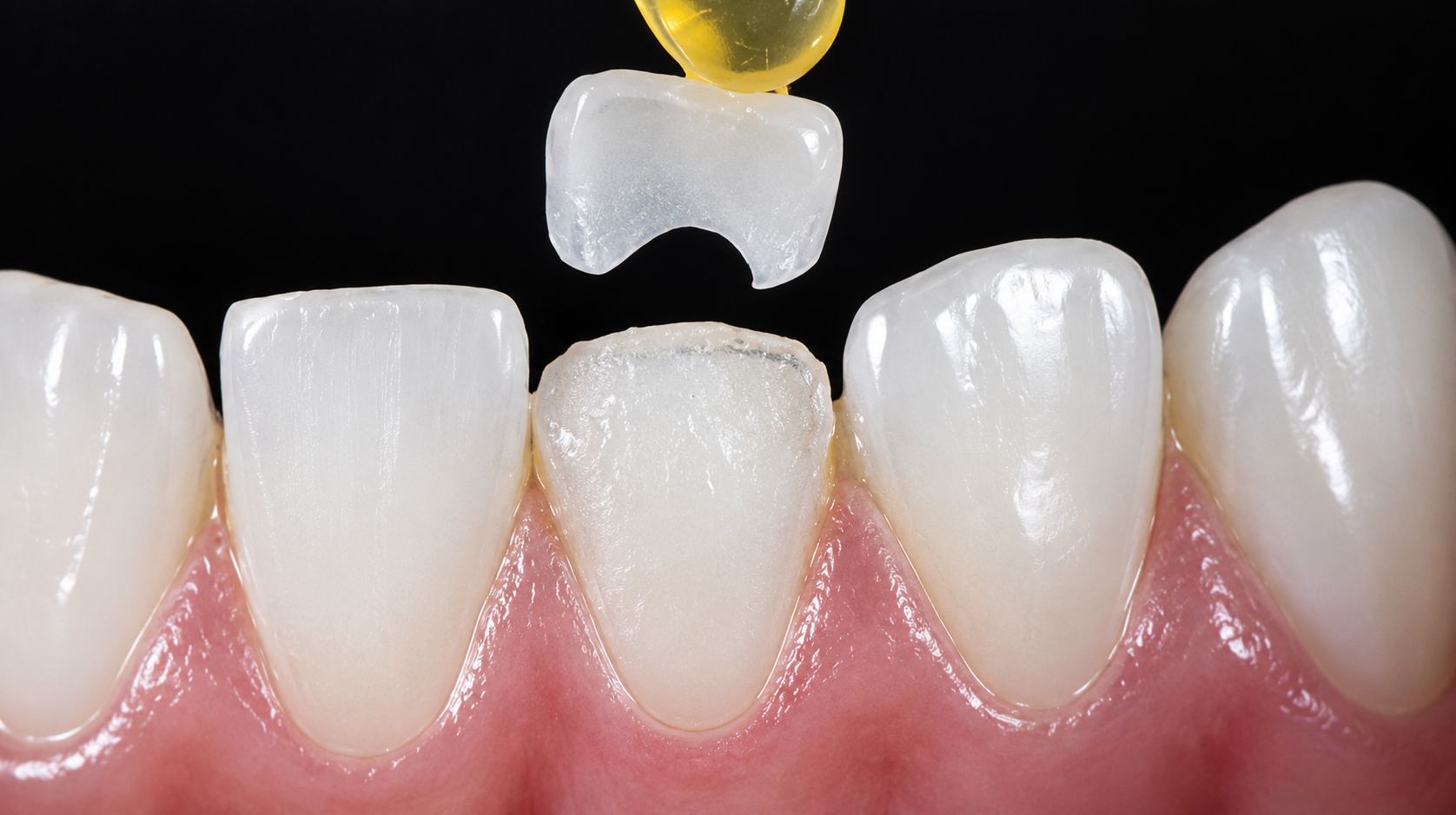
Chipping is the flaking of the veneering ceramic without fracture of the framework. It is one of the most frequent complications of layered restorations, particularly on zirconia. The good news: most of its causes are known, and can be prevented through joint work between the practice and the lab.
What exactly is chipping?
Chipping occurs when a fragment of veneering ceramic breaks off, most often on a cusp or an incisal edge. The framework remains intact. It is distinguished from delamination, where the ceramic separates from the framework at the interface.
Chipping is rarely due to a single cause. It most often results from a combination of factors related to design, fabrication and occlusion.
The main causes and how to avoid them
| Cause | What happens | Prevention |
|---|---|---|
| Non-anatomical framework | The ceramic is unsupported and works in tension | Reduced anatomical framework (cutback) that supports the cusps |
| Excessive or uneven ceramic thickness | Internal stresses and weak areas | Even veneering layer, ideally under 2 mm |
| Cooling too fast | Residual stresses, especially on zirconia, a poor thermal conductor | Slow, controlled cooling at the end of firing |
| Mismatched thermal expansion coefficients | Stresses at the framework/ceramic interface | Veneering ceramic suited to the framework material |
| Unfavorable occlusal contacts | Forces concentrated on thin ceramic | Checking contacts in lateral and protrusive movements |
| Bruxism and parafunctions | Repeated overload | Choosing monolithic and a night guard |
| Occlusal adjustment not repolished | Surface microcracks that propagate | Careful polishing or reglazing after adjustment |
The role of the lab
Designing a framework that supports the ceramic
Framework design is the first lever. A reduced anatomical framework ensures an even ceramic thickness and supports the load-bearing areas. It is the foundation of a durable layered restoration.
Controlling the firings
Firing parameters, and above all cooling, determine internal stresses. On zirconia, slow cooling is a reflex we apply systematically.
Offering monolithic or cutback when relevant
In high-load areas, monolithic zirconia eliminates the risk of chipping. An intermediate solution is to layer only the buccal surface and keep the occlusal surfaces monolithic.
The role of the practice
The dentist provides information the lab cannot guess: the patient's occlusal profile, their parafunctions, the available space. At seating, checking contacts in excursive movements is decisive. Any adjustment must be followed by careful polishing.
What to do in case of chipping?
A small chip outside the esthetic zone can often simply be polished. A more visible chip can be repaired in the mouth with composite, after appropriate surface preparation. When the chip is extensive or affects a load-bearing area, a remake is generally the most reliable solution. In every case, analyzing the cause prevents recurrence.
Going further
We devote a complete white paper to this subject: "Chipping in ceramic prosthetics". It details the mechanisms, the prevention protocols and the repair options. Our team remains available to review a case with you.
FAQ
Does chipping only affect zirconia?
No. It affects all layered restorations, including porcelain-fused-to-metal. Layered zirconia is simply more exposed without the right design and firing precautions.
Can a monolithic crown chip?
The risk is very low, since there is no separate veneering layer. That is why monolithic is preferred in high-load areas.
Can chipping be repaired in the mouth?
Yes, for a limited chip, with composite after surface preparation. For an extensive chip, a remake is more durable.
What veneering ceramic thickness should you aim for?
An even layer, generally under 2 mm, supported by an anatomical framework.