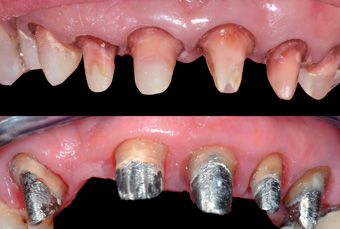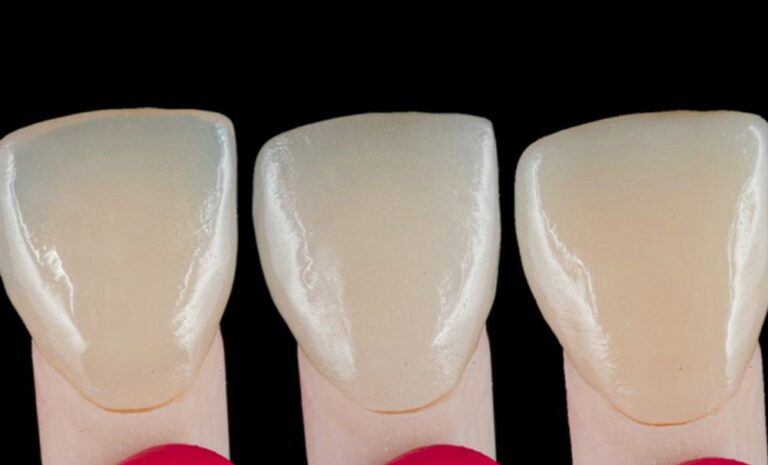
A badly damaged but salvageable tooth no longer systematically calls for a full crown. Bonding has made a more conservative approach possible: replace only what is missing. Inlay, onlay and overlay are three volumes of the same approach. You still need to know which one to choose, with which material and which thickness — and prepare the tooth accordingly.
Three volumes, one philosophy
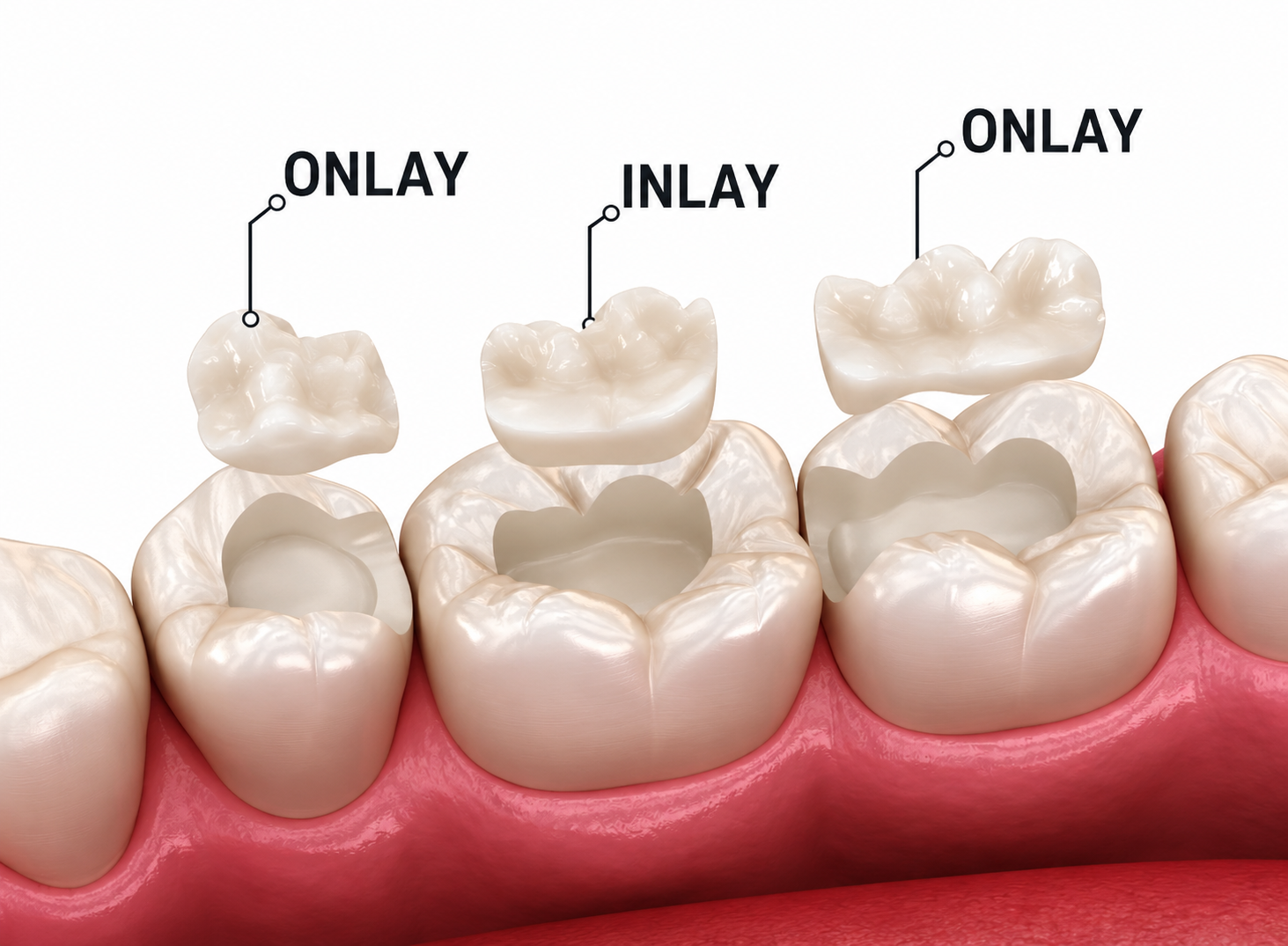
These three restorations share a common principle: relying on bonding that unites the restoration with the remaining tissues, rather than on mechanical retention obtained at the cost of further tooth destruction. They differ mainly in the extent of occlusal coverage.
The inlay
The inlay stays within the limits of the cavity, with no cusp coverage. It replaces a large filling when the marginal ridges need to be rebuilt, but the cusps, healthy and well supported by dentin, do not need protecting.
The onlay
The onlay covers one or more weakened cusps. It is the most common indication after removal of a large amalgam or in the presence of a limited crack: the cusp is protected rather than waiting for it to fracture, which often happens subgingivally and then compromises the tooth's prognosis.
The overlay
The overlay covers the entire occlusal table. It is used when all the cusps are weakened, after endodontic treatment of a badly damaged molar, or in wear rehabilitations where lost vertical dimension must be restored.
Choosing: the clinical benchmarks
The choice is based on three elements: the volume of remaining tissue, the condition of the cusps and the functional demand. The thicknesses below are orders of magnitude, to be systematically checked against the recommendations of the manufacturer of the chosen material.
| Clinical situation | Restoration | Commonly chosen material | Indicative occlusal thickness |
|---|---|---|---|
| Large cavity, healthy and supported cusps | Inlay | Lithium disilicate, composite | about 1.5 mm |
| One or two weakened cusps | Onlay | Lithium disilicate | about 1.5 to 2 mm on the covered cusp |
| Entire occlusal table to be covered | Overlay | Lithium disilicate, translucent zirconia | about 1 to 1.5 mm depending on the material |
| Non-vital tooth, thin remaining walls | Overlay, possibly with partial circumferential coverage | Depending on the available space | according to the manufacturer |
| Marked parafunction, reduced prosthetic space | Monolithic overlay or crown, to be discussed | Monolithic zirconia | according to the manufacturer |
The preparation points that make the difference
Preparing a bonded partial restoration follows different rules from a crown: retention does not come from wall height, but from adhesion. Six points come up in every case that goes well.
- Rounded internal angles: sharp angles concentrate stresses and make seating the restoration more difficult.
- Sufficient taper with no undercuts, for a single path of insertion that is clear on the model as well as on the file.
- Sharp margins, preferably supragingival or juxtagingival, so that a watertight rubber dam can be placed at the time of bonding.
- A regular circumferential chamfer or shoulder rather than a bevel on the occlusal enamel, which weakens the edge of the ceramic.
- Controlled occlusal reduction, checked in static and dynamic occlusion, ideally with a silicone index.
- Immediate dentin sealing when dentin is exposed, performed before the impression.
The material follows the indication, not the other way around
Lithium disilicate
It is the reference material for these restorations: it can be etched with hydrofluoric acid, which allows reliable bonding, and its optical properties remain close to those of the natural tooth. On the other hand, it requires a minimum thickness and bonding under a watertight rubber dam.
Translucent zirconias
They allow thinner sections and are suited to reduced prosthetic spaces or patients with parafunction. Their luting relies on a specific surface treatment — controlled sandblasting and a suitable primer — and not on etching.
Composites and hybrid resins
Less rigid, they absorb more stress and are easy to adjust chairside. They remain useful for long-term provisionalization or in young patients, but their surface ages less well than ceramic.
How Dune Dental supports you
With this type of restoration, most of the work happens before milling or pressing. We check the available occlusal space on the models or files before approving the material: insufficient thickness remains the most frequent cause of early overlay fracture. When space is lacking, we come back to you with a proposal — a modified preparation, a change of material — rather than with a fragile restoration.
We also specify on the delivery sheet the luting protocol for the material delivered, so that everything is ready before the bonding appointment. [To be completed: standard manufacturing lead time announced by Dune Dental for a bonded partial restoration] [To be completed: preferred contact channel to discuss a case before preparation]
FAQ
Can an overlay replace a crown on a non-vital tooth?
Often yes, as long as enough remaining walls are left and bonding can be performed under a watertight rubber dam. The decision depends more on the quantity and quality of the remaining tissue than on the pulpal status itself.
Is immediate dentin sealing essential?
As soon as dentin is exposed after preparation, it is recommended: it protects the dentin-pulp complex during provisionalization and improves the quality of the bonded joint. It must be performed before the impression, otherwise it would alter the intaglio of the restoration.
What is the difference between an overlay and a table top?
A table top is a thin overlay with no proximal extension, used mainly in wear rehabilitations. The principle is identical; only the extent of the preparation changes.
Are these restorations suited to digital impressions?
Yes, provided the margins are sharp and accessible. Partial restorations are in fact particularly well suited, as their margins are most often supragingival.